Mexican Mix With White Mexican Mix With White Babies
Multiracial Americans are at the cutting edge of social and demographic change in the U.S.—young, proud, tolerant and growing at a charge per unit three times as fast as the population every bit a whole.
As America becomes more racially diverse and social taboos against interracial marriage fade, a new Pew Research Heart survey finds that majorities of multiracial adults are proud of their mixed-race background (60%) and feel their racial heritage has made them more open to other cultures (59%).
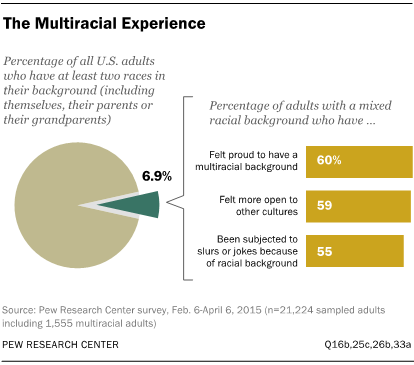 At the same fourth dimension, a bulk (55%) say they have been subjected to racial slurs or jokes, and about one-in-four (24%) have felt bellyaching considering people accept made assumptions virtually their racial background. Still, few see their multiracial groundwork as a liability. In fact, but 4% say having a mixed racial background has been a disadvantage in their life. Virtually 1-in-five (19%) say it has been an advantage, and 76% say it has made no difference.
While multiracial adults share some things in common, they cannot exist easily categorized. Their experiences and attitudes differ significantly depending on the races that make upwards their background and how the globe sees them. For example, multiracial adults with a black groundwork—69% of whom say most people would view them every bit black or African American—have a set of experiences, attitudes and social interactions that are much more closely aligned with the black customs. A different pattern emerges amidst multiracial Asian adults; biracial white and Asian adults feel more closely connected to whites than to Asians. Amidst biracial adults who are white and American Indian—the largest group of multiracial adults—ties to their Native American heritage are frequently faint: But 22% say they take a lot in common with people in the U.S. who are American Indian, whereas 61% say they have a lot in mutual with whites.1
 The U.S. Census Agency finds that, in 2013, nigh 9 million Americans chose 2 or more racial categories when asked about their race.2 The Census Bureau first started allowing people to cull more than 1 racial category to describe themselves in 2000. Since then, the nation'south multiracial population has grown essentially. Between 2000 and 2010, the number of white and black biracial Americans more doubled, while the population of adults with a white and Asian background increased by 87%. And during that decade, the nation elected as president Barack Obama—the son of a black male parent from Republic of kenya and a white mother from Kansas.
The share of multiracial babies has risen from one% in 1970 to 10% in 2013.iii And with interracial marriages as well on the rise, demographers expect this rapid growth to continue, if not quicken, in the decades to come.
Try our email form on the U.Due south. census
Acquire nigh why and how the U.Southward. demography is conducted through v brusque lessons delivered to your inbox every other day.
Sign up now!
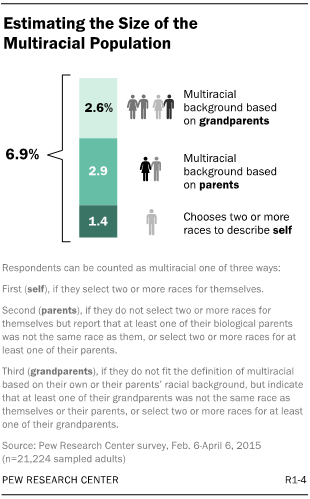
Still the Pew Inquiry survey findings propose that the census'due south estimate that 2.1% of the adult population is multiracial may understate the size of the land's mixed-race population. Taking into business relationship how adults describe their own race equally well equally the racial backgrounds of their parents and grandparents—which the census count does not do— Pew Research estimates that 6.9% of the U.S. adult population could be considered multiracial. This estimate comprises 1.4% in the survey who chose ii or more races for themselves, an additional 2.9% who chose one race for themselves but said that at least one of their parents was a different race or multiracial, and two.6% who are counted as multiracial because at least one of their grandparents was a different race than them or their parents.4
These findings sally from a nationally representative survey of 1,555 multiracial Americans ages 18 and older, conducted online from February. half-dozen to Apr half dozen, 2015. The sample of multiracial adults was identified after contacting and collecting bones demographic data on more than 21,000 adults nationwide. For comparative purposes, an additional one,495 adults from the general public were surveyed, including an oversample of non-Hispanic adults who are black and take no other races in their background and who are Asian and no race.
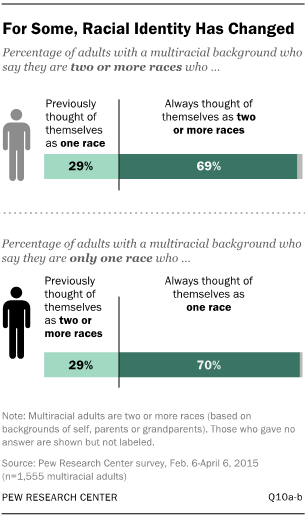 To be sure, not all adults with a mixed racial groundwork consider themselves "multiracial." In fact, 61% do non. An added layer of complication is that racial identity can exist fluid and may change over the grade of one'due south life, or even from 1 state of affairs to another. About three-in-ten adults with a multiracial groundwork say that they have changed the way they draw their race over the years—with some saying they once thought of themselves every bit only one race and now call back of themselves as more than 1 race, and others saying simply the opposite.
In addition to painting a portrait of multiracial Americans, the survey findings challenge some traditional ideas virtually race. The Census Agency currently recognizes five racial categories: white, blackness or African American, American Indian or Alaska Native, Asian, and Native Hawaiian or Pacific Islander. Hispanic origin is asked about separately every bit an ethnicity and is non considered a race.
Simply when Latinos are asked whether they consider being Hispanic to be function of their racial or ethnic background, the survey finds that about 2-thirds of Hispanics say it is, at least in part, their race. For the majority of this report, Hispanic origin is treated as an ethnicity, rather than a race, and multiracial Hispanics are those who say they are Hispanic and 2 separate races (for example, someone who is Hispanic and also chooses black and white as his or her races). This is consequent with how the Census Agency counts mixed-race Hispanics. However, because Hispanic identity is tied to both race and ethnicity for many Latinos, Chapter 7 of this report explores a broader definition of mixed race.
The Multiracial Experience
The survey finds that many multiracial adults, like other racial minorities, have experienced some type of racial discrimination, from racist slurs to physical threats, considering of their racial background.
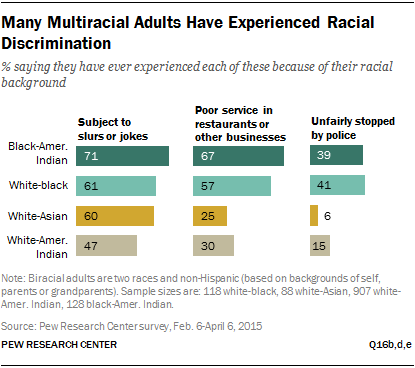 Again, the specific races that make upwards an individual'due south groundwork matter. For example, while about 4-in-ten mixed-race adults with a black background say they have been unfairly stopped by the police considering of their racial groundwork, just vi% of biracial white and Asian adults and 15% of white and American Indian adults say they accept had this experience. A similar pattern is evident for other types of racial discrimination.
For multiracial adults with a black background, experiences with bigotry closely mirror those of single-race blacks. Among adults who are black and no other race, 57% say they have received poor service in restaurants or other businesses, identical to the share of biracial black and white adults who say this has happened to them; and 42% of unmarried-race blacks say they accept been unfairly stopped past the law, as practice 41% of biracial black and white adults. Mixed-race adults with an Asian background are about as likely to report being discriminated against as are single-race Asians, while multiracial adults with a white groundwork are more than likely than single-race whites to say they have experienced racial discrimination.
Demographically, multiracial Americans are younger—and strikingly and so—than the state as a whole. According to Pew Research Middle analysis of the 2013 American Community Survey, the median historic period of all multiracial Americans is nineteen, compared with 38 for single-race Americans.
 The Pew Research survey finds that multiracial adults also are less likely than other adults to be higher graduates and less likely to be currently married. Simply when they practice wed, mixed-race Americans are more likely than other adults to marry someone who likewise is multiracial. Mixed-race adults are also more than probable than the full general public to have shut friends or neighbors who are multiracial.
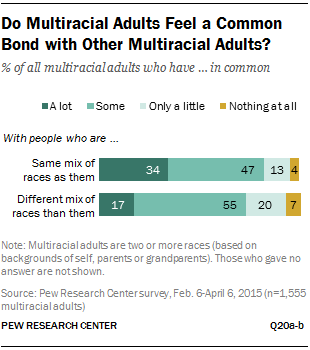
Even so, shared multiracial backgrounds exercise not necessarily interpret into shared identity. Only about a tertiary (34%) of all multiracial Americans call up they have a lot in common with other adults who are the same racial mix that they are, while only half as many (17%) call back they share a lot with multiracial Americans whose racial background is dissimilar from their ain.
The Size of the Multiracial Population
Information technology was less than l years ago that the U.S. Supreme Court, in the example begetting the evocative title Loving v. Virginia, struck down laws prohibiting mixed-race marriages. And it has been but fifteen years since the U.South. Census Bureau starting time immune Americans to choose more than 1 race when filling out their census grade.
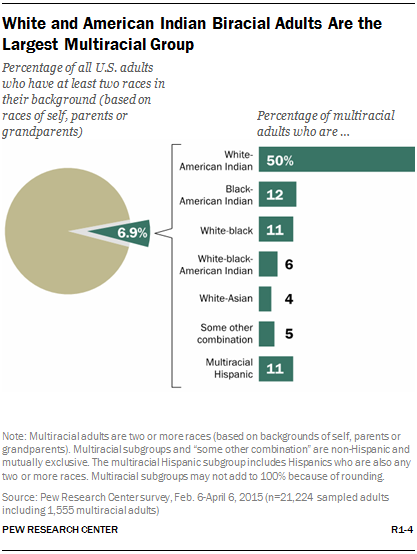 Since and so the multiracial population has grown significantly. To mensurate its size, the Pew Research Center used a different method than the Census Bureau for determining an individual's racial groundwork. In addition to cocky-reported race, Pew Research took into account the racial backgrounds of parents and grandparents. This approach led to the estimate that multiracial adults currently make up 6.nine% of the developed American population.
Using this definition, the Pew Research survey finds that biracial adults with a white and American Indian background comprise one-half of the country'southward multiracial population—by far the land'southward largest multiracial group simply also the one whose members are the to the lowest degree likely to consider themselves "multiracial" despite their mixed-race background.5
Black and American Indian biracial adults account for an additional 12% of the total multiracial adult population, while those with a white and black background make up 11%. Those with white, black and American Indian in their racial background brand up 6% of the mixed-race population, and white and Asian biracial adults business relationship for 4%. An boosted 11% are Hispanic multiracial adults.six The remaining share of the mixed-race population is scattered across the xvi other combinations of races represented in the Pew Research sample.
The relatively pocket-size share of all U.S. adults who are mixed race obscures the rapid growth of the multiracial population. If current trends continue—and bear witness suggests they may accelerate—the Census Bureau projects that the multiracial population will triple by 2060.
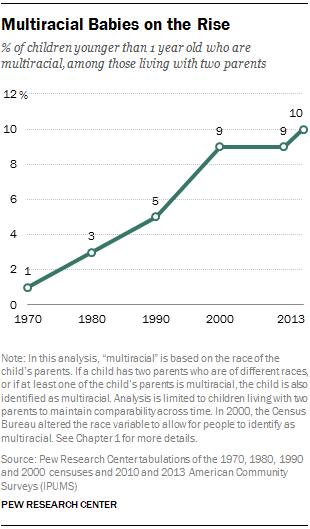 Feeding this growth is the increase in mixed-race couples and, as a natural consequence, births of children who have a multiracial groundwork. For example, since 1980 the share of marriages between spouses of different races has increased near fourfold (from i.6% to 6.3% in 2013).
The share of multiracial children is growing at an fifty-fifty faster rate. In 1970, amid babies living with 2 parents, only one% had parents who were dissimilar races from each other. By 2013, that share had risen to 10%.seven Today, nigh half (46%) of all multiracial Americans are younger than xviii. Past contrast, only 23% of the overall U.Due south. population is nether the historic period of 18.
As the multiracial population in the U.S. grows, its contour is as well irresolute. While biracial white and American Indian is currently the predominant group among mixed-race adults, in 2013 a majority of mixed-race babies8 were either biracial white and black (36%) or biracial white and Asian (24%). Some eleven% were white and American Indian.
The Multiracial Identity Gap
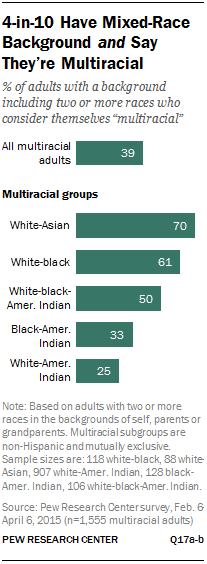 Multiracial identity is complicated, as much an attitude that can change over a lifetime every bit it is a genetic or biological certainty. Only iv-in-x adults with a mixed racial background (39%) say they consider themselves to be "mixed race or multiracial." Fully 61% say they don't consider themselves to be multiracial.
When asked why they don't place as multiracial, about half (47%) say it is because they wait like i race. An identical share say they were raised as 1 race, while about four-in-x (39%) say they closely identify with a single race. And nigh a third (34%) say they never knew the family fellow member or antecedent who was a dissimilar race. (Individuals were allowed to select multiple reasons.)
This multiracial "identity gap" plays out in distinctly different ways in different mixed-race groups. A quarter of biracial adults with a white and American Indian groundwork say they consider themselves multiracial. By contrast, vii-in-ten white and Asian biracial adults and 61% of those with a white and black background say they identify as multiracial.
For some mixed-race Americans, the pressure to identify as a single race is a significant part of the multiracial feel. According to the survey, well-nigh one-in-5 (21%) say they accept felt pressure level from friends, family unit or "society in general" to identify as a unmarried race.
A similar share says they have attempted to look or deport a certain way in gild to influence the way others perceive their race.
The style racial identity is classified in the U.Due south. has evolved over 200 years equally Americans' views about their ain backgrounds accept changed and equally the racial and ethnic fabric of the nation has been transformed through immigration and demographic alter. Nationally, the single largest data drove on Americans' racial identity is the U.S. Census Agency's decennial demography. The decennial census and other Census Bureau surveys at present categorize people into the following racial groups: white, black or African American, American Indian or Alaskan Native, Asian, Native Hawaiian or other Pacific Islander and "some other race." Prior to the 2000 census, respondents were immune to choose merely one racial category to depict themselves. Since 2000, respondents have had the selection to choose more than than ane race. People who mark two or more races in their answer to the race question are included in the multiple-race population by the Census Bureau. Although respondents are also asked, in a carve up question, about their Hispanic or Latino origin, only answers to the race question are used in classifying people into the multiple-race population.
While the definition of multiracial adults used in virtually of the analysis independent in this report is guided by the Demography Agency'south definition of race, nosotros know that many Hispanics consider Hispanicity to be a race. In our survey, for example, roughly two-thirds of Hispanics say existence Hispanic is part of their racial groundwork. With that in mind, a separate part of our analysis includes an expanded definition of multiracial that includes Hispanics who report one demography race for themselves, their parents and their grandparents and besides say they consider being Hispanic part of their racial groundwork. Chapter 7 of this written report focuses on the experiences and attitudes of multiracial Hispanics, using both the census-based and the expanded definitions.
For a more than detailed description of our methodology, see Appendix A.
Being Mixed Race
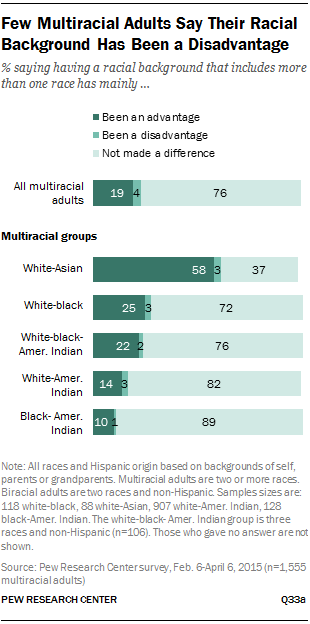 A majority of multiracial adults say they are proud of their mixed racial background (lx%), more see their racial background as an advantage than a disadvantage (19% vs. 4%), and they overwhelmingly say they have rarely if ever felt ashamed or similar an outsider because of their mixed racial groundwork.
While these views are broadly shared by each of the five biggest multiracial groups, the large proportion of white and Asian biracial adults who see their racial background every bit an advantage stands out. About six-in-ten in this group (58%) say their racial groundwork has been an advantage to them in life. In the other four groups, only almost one-in-four or fewer say their racial heritage has been as helpful.
This contrast farther sharpens when white and Asian biracial Americans are compared with single-race whites and Asians. Co-ordinate to the survey, white and Asian biracial Americans are even more likely than single-race whites (58% vs. 32%, respectively) or Asians (fifteen%) to say their racial background has been an advantage.
 Mixed-race adults frequently straddle two or more worlds, and their experiences and relationships reflect that.
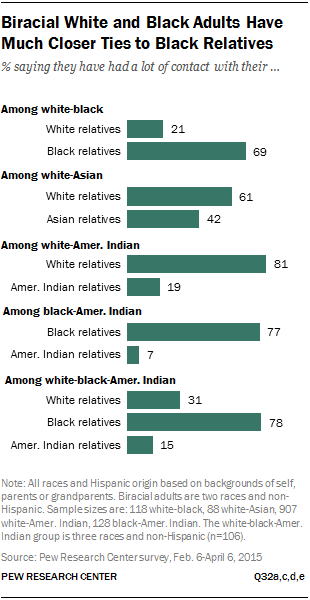
Overall, biracial adults who are both white and black are three times as likely to say they have a lot in mutual with people who are black than they do with whites (58% vs. 19%). They also feel more than accepted by blacks than by whites (58% vs. 25% say they are accepted "very well") and written report having far more contact with their blackness relatives: 69% say they've had a lot of contact with family unit members who are black over the course of their lives, while just 21% written report similar levels of contact with their white relatives. About four-in-ten (41%) say they have had no contact with family unit members who are white.
Past dissimilarity, biracial adults who are white and Asian say they have more in mutual with whites than they do with Asians (60% vs. 33%) and are more likely to say they feel accepted by whites than by Asians (62% vs. 47% say they are accepted "very well"). More than too say they have had a lot of contact with family members who are white than say the same virtually Asian members of their family unit (61% vs. 42%).
For biracial adults who are white or black and American Indian, their connections with the white or black customs are often stronger than the ones they experience toward Native Americans; nigh one-in-four or fewer in each grouping say they have a lot in mutual with American Indians.
Other survey findings propose these differences may tedious the development of a multiracial grouping identity similar to the sense of linked fate and shared feel that unites many blacks and other minority groups.9 Overall, the Pew Enquiry survey finds that few multiracial adults think they have much in mutual with other mixed-race Americans—fifty-fifty those who share their racial background.
Marriage and Friendships
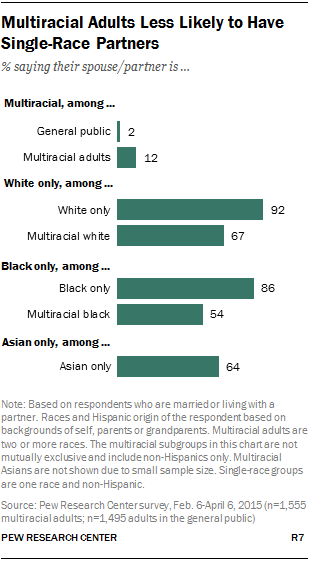 As a group, mixed-race adults are much more likely than all married adults to take a spouse or partner who is likewise multiracial, the survey finds. Amidst all mixed-race adults who are married or living with a partner, nearly one-in-viii (12%) say their spouse or partner is 2 or more races. By comparison, only 2% of adults among the general public who are married or living with a partner say the same.
The survey also finds that multiracial adults with a white background are significantly less likely than single-race whites to have a white partner (67% vs. 92%). Multiracial adults with a blackness groundwork are also less likely than single-race blacks to have a spouse or partner who is black but (54% vs. 86%).10
A similar pattern emerges when the focus turns to the friendships formed by multiracial Americans. Mixed-race adults are more than likely than the general public to have friends who are multiracial. Co-ordinate to the survey, eight-in-ten multiracial adults say at to the lowest degree some of their friends are mixed-race, compared with 62% for all adults.
The Politics of Multiracial Americans
Overall, the politics of multiracial Americans resemble the state as a whole. Nearly 6-in-ten (57%) multiracial adults identify with or lean toward the Democratic Party, while 37% support or lean toward the Republican Party, and 6% favor neither major party. Amongst the general public, well-nigh half (53%) tend to favor Democrats, while 41% support or lean toward the GOP.
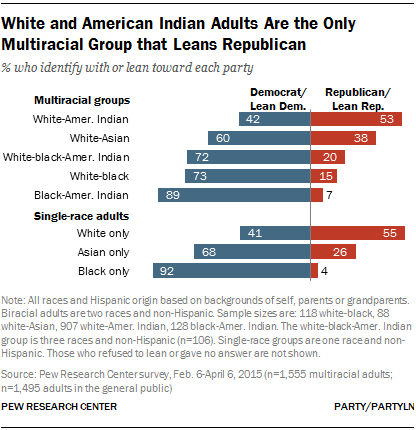 But merely as the state is a mix of individuals and groups with different party preferences and ideological leanings, multiracial Americans are likewise politically various.
Multiracial Americans with a black background favor the Autonomous Party, similar to the party preferences of single-race blacks. For example, about 9-in-ten biracial black and American Indian adults (89%) identify or lean toward the Autonomous Party, as do 92% of all single-race blacks. By dissimilarity, single-race whites favor the Republican Political party over the Democrats by a ratio of 55% to 41%.
White and Asian biracial adults also tend to favor the Democratic Party over the GOP (60% vs. 38%), roughly similar to the 68% to 26% advantage held by Democrats among unmarried-race Asians.
The political leanings of biracial white and American Indians—the country's largest multiracial group—closely resemble those of single-race whites. Among this group, the Republican Party holds a 53% to 42% advantage over the Democrats, making it the only major mixed-race group that tilts toward the GOP. (The sample of single-race Native Americans was also pocket-sized to analyze.)
The residual of this report examines in greater detail the attitudes, experiences and demographics of multiracial Americans. Affiliate 1 traces the history of efforts by the U.Due south. Census Agency to mensurate race and reports on the latest government estimates of the size of the multiracial population. Chapter two describes how the Pew Research Eye used a different method than the Census Agency to measure racial background and how that method produces a significantly larger approximate of the land'south multiracial population. Affiliate 3 describes how multiracial adults see their own racial identity and how they believe others see their racial background. Chapter 4 focuses on how the racial backgrounds of the country's largest multiracial groups shape their attitudes and experiences in unlike ways, including the likelihood they have encountered racial bigotry. Chapter five describes the social connections of multiracial Americans, including how much mixed-race adults say they have in common with other races and how accepted they feel by different racial groups. Affiliate 6 examines the political party preferences and political ideology of multiracial adults as well as their views on abortion, aid to the poor, marijuana legalization and other problems. Chapter 7 reports on the elements of Hispanic identity and the percentage of Hispanics who consider their Hispanic background to exist, at least in part, their race. Information technology also explores an expanded definition of multiracial adults that includes Hispanics who are 1 race but say they consider their Hispanic background to be part of their racial background.
Other Key Findings
- In their ideological preferences, white and American Indian biracial adults are the only group where political conservatives outnumber liberals (37% to 18%), virtually identical to the ideological preferences of single-race whites. Biracial Americans who are white and Asian or white and blackness tilt toward the political left.
- Few multiracial adults (9%) say a relative or fellow member of their extended family has treated them badly because they are mixed race. Merely these experiences vary considerably by multiracial group. For instance, white and black biracial adults are much more probable than adults with a biracial white and American Indian background to say they have been treated desperately past a family member (21% vs. 4%).
- Today'south mixed-race parents are more than likely to have talked to their own children well-nigh existence multiracial. Fully 46% of multiracial parents say they talked to their adult children when they were growing upwardly about having a mixed-race background. By contrast, about a third (32%) say their parents had like conversations with them.
- Ane-in-four mixed-race adults say people are oft or sometimes dislocated by their racial background. And 1-in-five (nineteen%) say that they accept felt like they were a go-between or "bridge" between unlike racial groups.
- For multiracial adults, as for the general public, race is not the most important chemical element of their personal identity. Some 26% of multiracial adults say their racial background is "essential" to their identity (as do 28% of all adults). Both multiracial adults and the general public are much more than likely to point to gender (50% for multiracial adults, 51% for the general public) or faith (39% for both groups) as essential parts of their identity.
The terms "multiracial" and "mixed race" are used interchangeably throughout this report. For more details on how the sample of multiracial adults was divers, run across the "Defining 'Multiracial'" textbox on folio xiii or Appendix A. "Adults" are those who are ages 18 and older.
Unless otherwise noted, survey results based on all multiracial adults include Hispanics who are two or more than races. In analysis of the Pew Research survey, biracial groups and other subgroups such as "multiracial whites" include only non-Hispanics. Single-race whites, blacks and Asians include only non-Hispanics. In the analysis of multiracial subgroups based on census data (in Chapter 1), Hispanics are included.
Throughout this study, the terms "American Indian" and "Native American" are used interchangeably and "Amer. Indian" is used as an abbreviation in charts and tables. Alaska Natives are included among those with some American Indian background in the survey analysis.
The terms "Latino" and "Hispanic" are used interchangeably.
The terms "black" and "African American" are used interchangeably.
Source: https://www.pewresearch.org/social-trends/2015/06/11/multiracial-in-america/
0 Response to "Mexican Mix With White Mexican Mix With White Babies"
Post a Comment